The Inevitability of the Shift
2025 December 17 By: Harry de BontWhy “Impossible” Changes Suddenly Become Unavoidable
Introducing the Curvature Shift (CCAS) Framework for Strategic Forecasting
1. Executive Summary: The Paradox of Sudden Change
In business, policy, and geopolitics, leaders repeatedly encounter the same paradox. Certain changes—remote work, digital payments, AI adoption, geopolitical realignments—are dismissed for years as impossible, unthinkable, or culturally incompatible. Then, almost overnight, resistance evaporates. What was once taboo becomes obvious. What was once risky becomes mandatory.
Traditional forecasting frameworks often label these events “Black Swans.” This paper argues they are nothing of the sort.
These moments are Curvature Shifts: predictable, structural realignments that occur when the cost of denying reality finally exceeds the cost of accepting it. The change appears sudden not because it is random, but because mounting pressure has been accumulating beneath the surface, invisible to conventional metrics.
This paper introduces the Collective Curvature Acceptance Shift (CCAS) framework—a strategic diagnostic designed to detect these hidden pressures before they snap. Rather than measuring what people say they believe, CCAS focuses on something more fundamental: the alignment cost required to keep the current system functioning.
2. The Blind Spot: Why Organizations Miss the Signal
Why do sophisticated institutions repeatedly get blindsided by shifts that later feel obvious in hindsight? Because most forecasting tools rely on linear indicators to track non-linear systems.
The common error is straightforward:
- What we measure: Belief, sentiment, stated opinion.
- What actually matters: Alignment cost—the effort, risk, and energy required to keep operating within the existing model.
Most change models assume that transformation occurs when enough people are persuaded by better arguments or new information. In practice, acceptance often shifts before arguments change. People do not revise their beliefs first; they revise their calculus.
This creates a dangerous condition we call a False Vacuum: a state where a system appears stable on the surface but requires ever-increasing energy to maintain. The moment that maintenance cost crosses a critical threshold, stability collapses—not gradually, but asymmetrically.
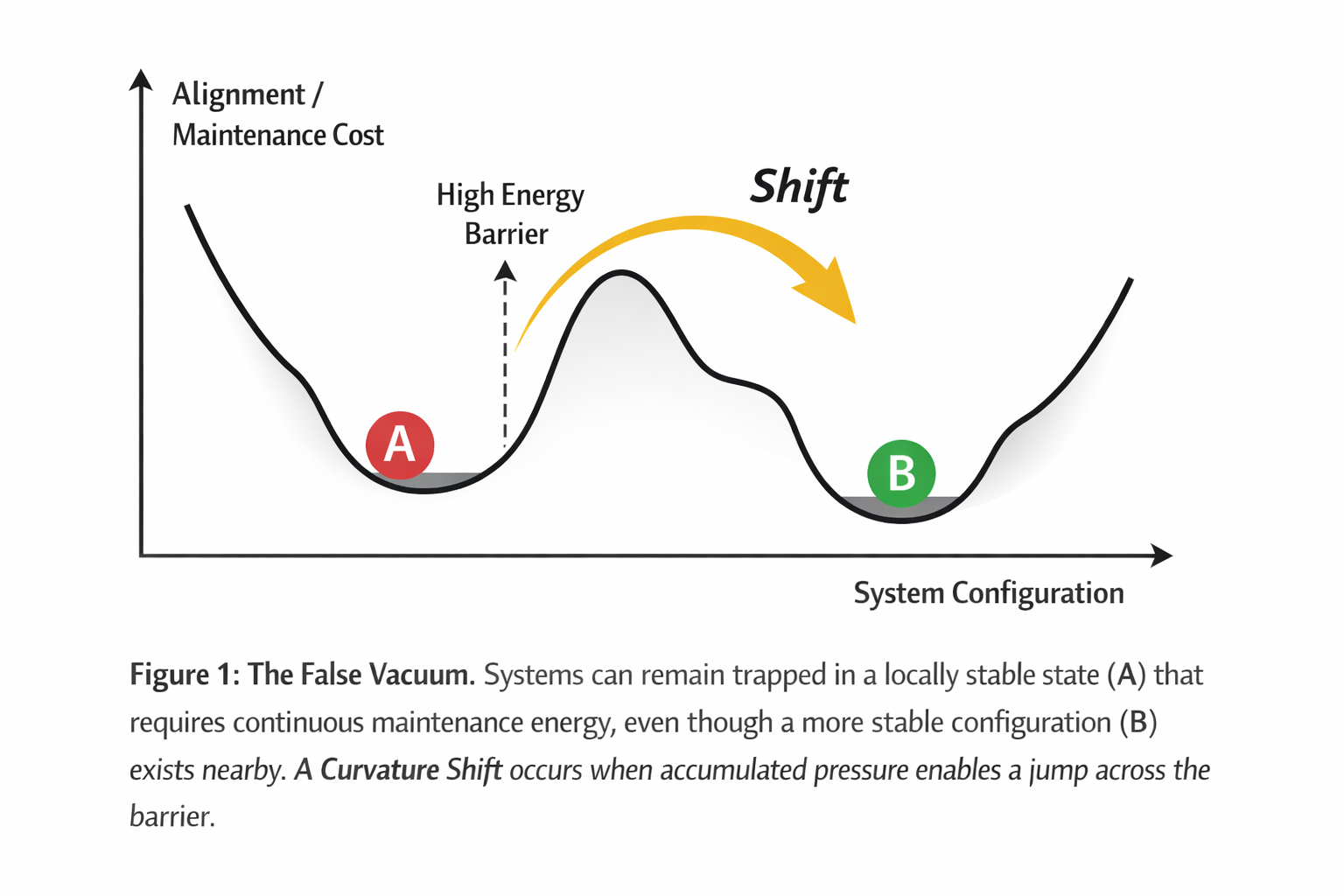
3. The Mechanism: How Shifts Actually Happen
CCAS begins from a simple premise: meaning behaves less like a list of ideas and more like a landscape. Individuals and organizations do not merely debate concepts; they navigate terrains of utility, risk, and social permission.
The Grass Path Principle
Imagine a paved walkway that takes a long detour. For years, people follow it because “that’s the rule.” A few start cutting across the grass. Over time, the grass thins. Eventually, the informal dirt path becomes the obvious—and later official—route.
The transition was not caused by a debate about pavement. It was caused by a shift in the cost of travel.
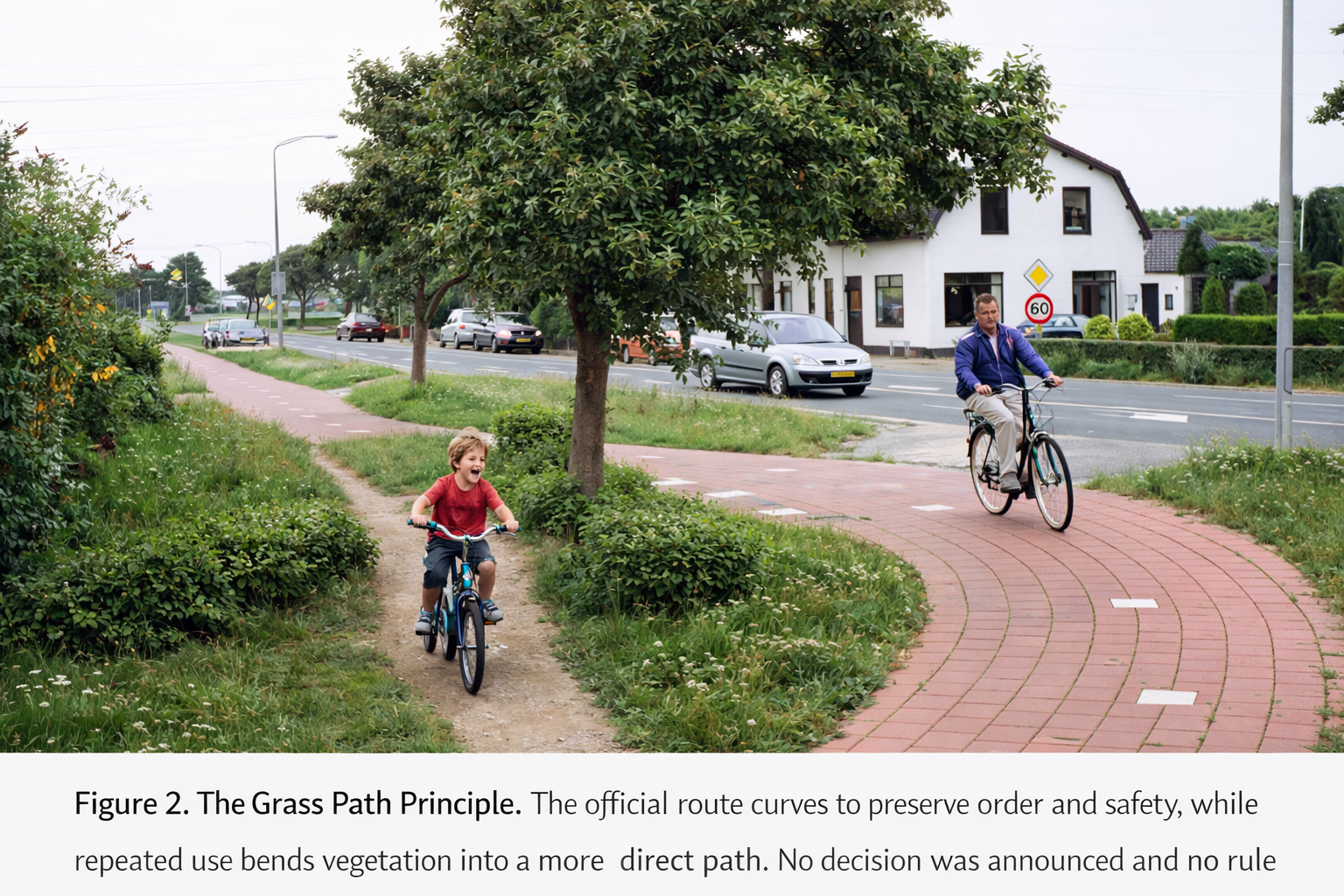
This is how major cultural, organizational, and political shifts unfold:
- Narrative (what is said publicly) lags behind utility (what actually works).
- Before the shift: Energy is spent suppressing misalignment to preserve social or institutional safety.
- The trigger: A minor event makes suppression more expensive than acceptance.
- The snap: Resistance does not mount a counteroffensive; it loses structural support and thins out.
The result feels sudden, even though the underlying realignment has been underway for years.
4. The CCAS Diagnostic: Are You in a False Vacuum?
CCAS is not a prediction engine. It is an early-warning diagnostic for meta-stability. The following three-phase checklist helps identify systems that appear stable but are approaching a critical threshold.
Phase 1: The Vibe Check (Emotional Valence)
- Private–Public Gap: Do leaders express one view privately while maintaining a contradictory public stance?
- Cynicism Dominance: Is the topic handled primarily through irony, memes, or sarcasm rather than earnest debate?
Phase 2: The Calculus Check (Utility)
- The “Stupid Tax”: Does compliance with official rules reliably produce worse outcomes than bending them?
- Enforcement Escalation: Is increasing energy required merely to maintain the baseline?
Phase 3: The Hollow Check (Narrative)
- Zombie Arguments: Are defenses recycled slogans that no longer engage with current realities?
- Elite Defection: Have influential insiders begun to subtly distance themselves from the prevailing norm?
Scoring Guide
- 0–3: Structurally stable
- 4–7: Primed
- 8+ (Critical): Meta-stable. A rapid shift is likely once a trigger appears.
5. Case Study: Conscription in Europe as a Decaying False Vacuum
To illustrate the framework, we apply the CCAS diagnostic to a topic widely considered “politically impossible”: the reintroduction of mandatory military or civil service in Europe.
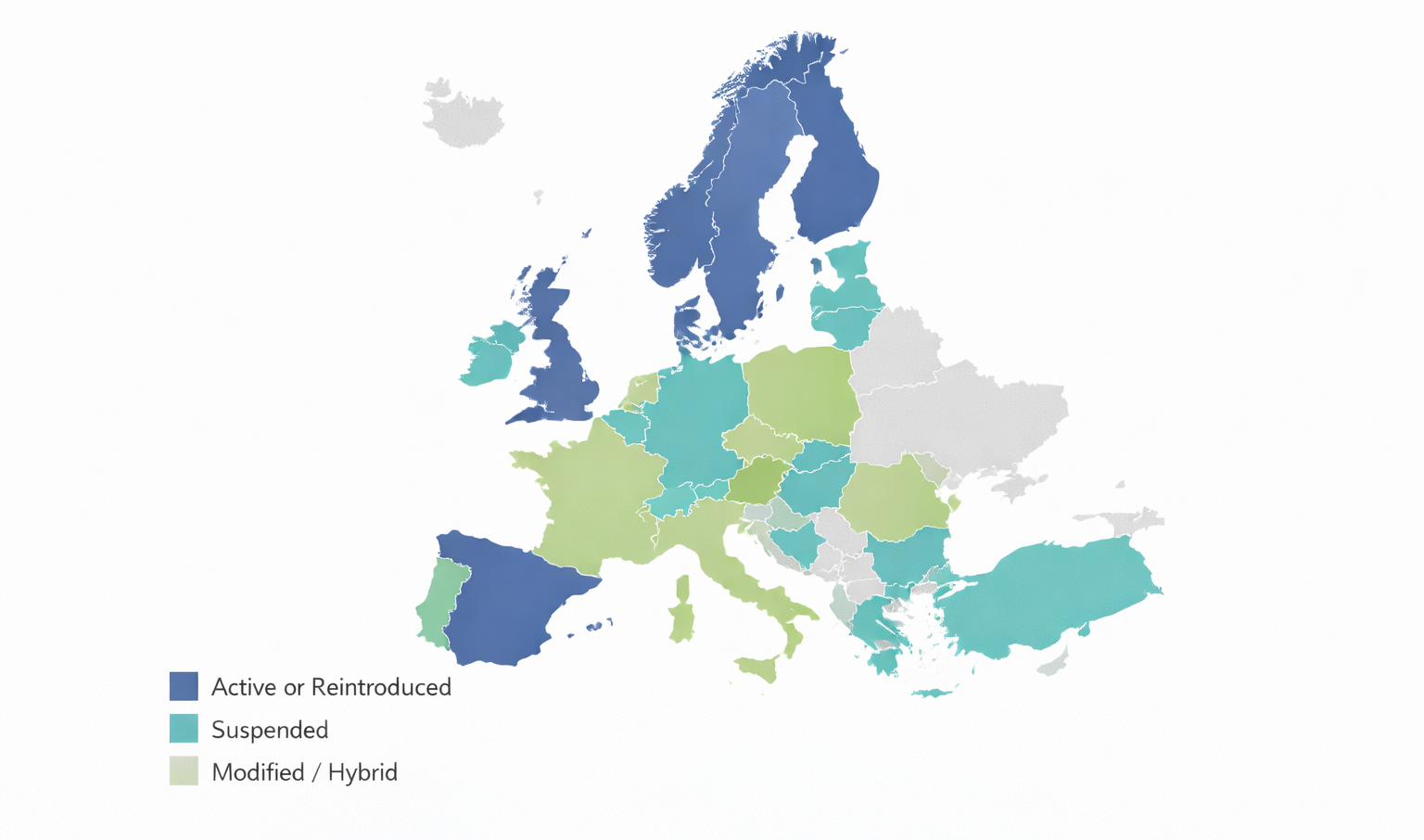
European states with active or reintroduced service (blue/green) indicate that opposition to conscription is no longer structurally uniform. The emerging pattern suggests increasing strain on the prevailing “no-go” narrative.
- Dominant Narrative: “Conscription is obsolete and politically suicidal.”
- Operational Reality: High-intensity warfare in Ukraine demonstrates sustained manpower requirements that professional volunteer forces struggle to meet.
Applying the CCAS checklist yields a score of 11/12 (Critical):
- Rising enforcement and recruitment costs
- Quiet experimentation with hybrid or soft-conscription models
- Increasing rhetorical distance between public assurances and private planning
Forecast (Analytic, not prescriptive): The current prohibition on conscription functions as a false vacuum. Alignment costs are rising faster than narrative credibility. When a triggering shock occurs—logistical, strategic, or alliance-based—expect a rapid reframing (e.g., “Civil Resilience,” “Total Defense”) followed by swift normalization. Opposition is unlikely to consolidate; it will fragment as the old narrative loses structural support.
This case illustrates structural pressure, not policy advocacy.
6. Limitations and Scope
CCAS is a structural diagnostic, not a deterministic oracle. It identifies pressure gradients, not precise outcomes.
- CCAS detects instability, not the exact form a shift will take.
- Some false vacuums persist longer than expected under coercion or heavy subsidy.
- Not all acceptance shifts stabilize; misalignment with reality can produce temporary, delusional equilibria that later collapse.
“Inevitability,” as used here, refers to sustained structural pressure under given constraints—not certainty of timing, scale, or success.
7. Conclusion: Preparing for the Snap
A Curvature Shift occurs when a system stops paying the energetic cost of suppressing reality. These moments are among the greatest risks—and opportunities—facing modern organizations.
Strategic failure often comes from listening too closely to what the market says while ignoring what it costs to maintain the status quo. CCAS offers a different lens: track alignment cost, not rhetoric.
When the cost of staying the same exceeds the cost of change, the shift is no longer merely possible. Under sustained constraints, it becomes structurally unavoidable.